教學:打造一個待辦事項管理器
在本教學中,我們將建立一個具備使用者驗證 (Authentication) 與授權 (Authorization) 的 todo manager MCP 伺服器。根據最新的 MCP 規範,我們的 MCP 伺服器將作為 OAuth 2.0 資源伺服器 (Resource Server),負責驗證存取權杖 (Access token) 並強制執行基於權限範圍 (Scope) 的權限。
完成本教學後,你將擁有:
- ✅ 基本瞭解如何在 MCP 伺服器中設定角色型存取控制 (RBAC, Role-based access control)
- ✅ 一個作為資源伺服器 (Resource Server) 的 MCP 伺服器,能消耗由授權伺服器 (Authorization Server) 發出的存取權杖 (Access token)
- ✅ 一個可運作的基於權限範圍 (Scope) 的權限控管實作,適用於 todo 操作
概覽
本教學將包含以下元件:
- MCP 用戶端 (MCP Inspector):一個用於測試 MCP 伺服器的視覺化工具,作為 OAuth 2.0 / OIDC 用戶端。它會啟動授權流程,並向 MCP 伺服器發送帶有存取權杖 (Access token) 的請求。
- 授權伺服器 (Authorization Server):一個 OAuth 2.1 或 OpenID Connect 簽發者 (Issuer),負責管理使用者身分、驗證使用者,並向授權用戶端發出帶有適當權限範圍 (Scope) 的存取權杖 (Access token)。
- MCP 伺服器 (Resource Server):根據最新 MCP 規範,MCP 伺服器在 OAuth 2.0 架構中作為資源伺服器 (Resource Server)。它驗證授權伺服器發出的存取權杖 (Access token),並根據權限範圍 (Scope) 強制執行 todo 操作的權限。
此架構遵循標準 OAuth 2.0 流程:
- MCP Inspector 代表使用者請求受保護資源
- 授權伺服器 (Authorization Server) 驗證使用者並發出存取權杖 (Access token)
- MCP 伺服器 (Resource Server) 驗證權杖並根據授權權限提供受保護資源
以下是這些元件互動的高階流程圖:
瞭解你的授權伺服器
具備權限範圍 (Scope) 的存取權杖 (Access tokens)
若要在 MCP 伺服器中實作 角色型存取控制 (RBAC),你的授權伺服器需支援發出帶有權限範圍 (Scope) 的存取權杖 (Access token)。權限範圍 (Scope) 代表使用者被授予的權限。
- Logto
- OAuth 2.0 / OIDC
Logto 透過其 API 資源 (API resources)(符合 RFC 8707: OAuth 2.0 資源標示符 (Resource Indicators))與角色 (Roles) 功能提供 RBAC 支援。設定方式如下:
-
登入 Logto Console(或你的自架 Logto Console)
-
建立 API 資源與權限範圍 (Scope):
- 前往「API 資源」
- 建立一個名為「Todo Manager」的新 API 資源
- 新增以下權限範圍 (Scope):
create:todos:「建立新的待辦事項」read:todos:「讀取所有待辦事項」delete:todos:「刪除任一待辦事項」
-
建立角色(建議以便管理):
- 前往「角色」
- 建立「Admin」角色並指派所有權限範圍(
create:todos、read:todos、delete:todos) - 建立「User」角色並僅指派
create:todos權限範圍
-
指派權限:
- 前往「使用者」
- 選擇一位使用者
- 你可以:
- 在「角色」分頁指派角色(建議)
- 或直接在「權限」分頁指派權限範圍
權限範圍 (Scope) 會以空格分隔字串的形式包含在 JWT 存取權杖 (Access token) 的 scope 宣告 (Claim) 中。
OAuth 2.0 / OIDC 簽發者 (Issuer) 通常支援基於權限範圍 (Scope) 的存取控制。實作 RBAC 時:
- 在授權伺服器中定義所需的權限範圍 (Scope)
- 設定用戶端在授權流程中請求這些權限範圍
- 確保授權伺服器在存取權杖 (Access token) 中包含授予的權限範圍
- 權限範圍通常會包含在 JWT 存取權杖的
scope宣告 (Claim) 中
請查閱你的簽發者 (Issuer) 文件以瞭解:
- 如何定義與管理權限範圍 (Scope)
- 權限範圍如何包含在存取權杖 (Access token) 中
- 是否有額外的 RBAC 功能如角色管理
權杖驗證與權限檢查
根據最新 MCP 規範,MCP 伺服器在 OAuth 2.0 架構中作為 資源伺服器 (Resource Server)。作為資源伺服器,MCP 伺服器有以下職責:
- 權杖驗證:驗證從 MCP 用戶端收到的存取權杖 (Access token) 的真實性與完整性
- 權限範圍強制執行:從存取權杖中擷取並驗證權限範圍 (Scope),以決定用戶端被授權執行哪些操作
- 資源保護:僅在用戶端提供有效且具備足夠權限的權杖時,才提供受保護資源(執行工具)
當 MCP 伺服器收到請求時,會執行以下驗證流程:
- 從
Authorization標頭擷取存取權杖(Bearer 權杖格式) - 驗證存取權杖的簽章與有效期限
- 從已驗證的權杖中擷取權限範圍與使用者資訊
- 檢查權杖是否具備執行請求操作所需的權限範圍
例如,若使用者要建立新的待辦事項,其存取權杖必須包含 create:todos 權限範圍。以下為資源伺服器驗證流程:
動態用戶端註冊 (Dynamic Client Registration)
本教學不強制要求動態用戶端註冊,但若你想自動化 MCP 用戶端在授權伺服器的註冊流程,可參考 是否需要動態用戶端註冊? 以取得更多資訊。
瞭解 todo manager 中的 RBAC
為了示範,我們會在 todo manager MCP 伺服器中實作一個簡單的角色型存取控制 (RBAC) 系統。這將讓你瞭解 RBAC 的基本原理,同時保持實作簡潔。
雖然本教學以 RBAC 為基礎進行權限範圍管理,但需注意並非所有驗證 (Authentication) 簽發者 (Issuer) 都透過角色來管理權限範圍。有些簽發者可能有自己獨特的存取控制與權限管理機制。
工具與權限範圍 (Scope)
我們的 todo manager MCP 伺服器提供三個主要工具:
create-todo:建立新的待辦事項get-todos:列出所有待辦事項delete-todo:根據 ID 刪除待辦事項
為了控管這些工具的存取,我們定義以下權限範圍 (Scope):
create:todos:允許建立新的待辦事項delete:todos:允許刪除現有待辦事項read:todos:允許查詢並取得所有待辦事項列表
角色與權限
我們將定義兩個不同存取層級的角色:
| 角色 | create:todos | read:todos | delete:todos |
|---|---|---|---|
| Admin | ✅ | ✅ | ✅ |
| User | ✅ |
- User:一般使用者,可建立待辦事項,僅能檢視或刪除自己的待辦事項
- Admin:管理員,可建立、檢視並刪除所有待辦事項,不論擁有者為誰
資源擁有權
雖然上表明確列出每個角色被指派的權限範圍 (Scope),但還有一個重要的資源擁有權原則:
- User 沒有
read:todos或delete:todos權限範圍,但仍可:- 檢視自己的待辦事項
- 刪除自己的待辦事項
- Admin 具備完整權限(
read:todos與delete:todos),可:- 檢視系統中所有待辦事項
- 刪除任何待辦事項,不論擁有者為誰
這展現了 RBAC 系統中常見的模式:資源擁有權會隱含授予使用者對自己資源的權限,而管理角色則獲得對所有資源的明確權限。
想更深入瞭解 RBAC 概念與最佳實踐,請參考 精通 RBAC:完整實戰範例。
在你的簽發者 (Issuer) 中設定授權 (Authorization)
要實作上述存取控制系統,你需要在授權伺服器設定所需的權限範圍 (Scope)。以下是不同簽發者的設定方式:
- Logto
- OAuth 2 / OIDC
Logto 透過 API 資源與角色功能提供 RBAC 支援。設定方式如下:
-
登入 Logto Console(或你的自架 Logto Console)
-
建立 API 資源與權限範圍 (Scope):
- 前往「API 資源」
- 建立一個名為「Todo Manager」的新 API 資源,並將
http://localhost:3001設為資源標示符 (Resource indicator)。- 重要:資源標示符必須與你的 MCP 伺服器 URL 相符。本教學使用
http://localhost:3001,因 MCP 伺服器運行於 3001 埠。正式環境請使用實際 MCP 伺服器 URL(如https://your-mcp-server.example.com)。
- 重要:資源標示符必須與你的 MCP 伺服器 URL 相符。本教學使用
- 建立以下權限範圍 (Scope):
create:todos:「建立新的待辦事項」read:todos:「讀取所有待辦事項」delete:todos:「刪除任一待辦事項」
-
建立角色(建議以便管理):
- 前往「角色」
- 建立「Admin」角色並指派所有權限範圍(
create:todos、read:todos、delete:todos) - 建立「User」角色並僅指派
create:todos權限範圍 - 在「User」角色詳細頁切換至「一般」分頁,將「User」設為「預設角色」
-
管理使用者角色與權限:
- 新使用者:
- 由於已設為預設角色,將自動獲得「User」角色
- 現有使用者:
- 前往「使用者管理」
- 選擇一位使用者
- 在「角色」分頁指派角色
- 新使用者:
你也可以使用 Logto 的 Management API 以程式方式管理使用者角色。這對自動化使用者管理或建立管理後台特別有用。
請求存取權杖時,Logto 會根據使用者角色權限將權限範圍 (Scope) 加入權杖的 scope 宣告 (Claim)。
對於 OAuth 2.0 或 OpenID Connect 簽發者 (Issuer),你需要設定代表不同權限的權限範圍 (Scope)。具體步驟依簽發者而異,但一般流程如下:
-
定義權限範圍 (Scope):
- 設定授權伺服器支援:
create:todosread:todosdelete:todos
- 設定授權伺服器支援:
-
設定用戶端:
- 註冊或更新用戶端以請求這些權限範圍
- 確保權限範圍會包含在存取權杖中
-
指派權限:
- 使用簽發者介面將適當權限範圍指派給使用者
- 有些簽發者支援基於角色的管理,有些則直接指派權限範圍
- 請查閱簽發者文件以獲得建議做法
大多數簽發者會將授予的權限範圍包含在存取權杖的 scope 宣告 (Claim) 中。格式通常為以空格分隔的權限範圍字串。
設定好授權伺服器後,使用者將收到包含其授權權限範圍的存取權杖。MCP 伺服器會根據這些權限範圍判斷:
- 使用者是否能建立新的待辦事項(
create:todos) - 使用者是否能檢視所有待辦事項(
read:todos)或僅能檢視自己的 - 使用者是否能刪除任一待辦事項(
delete:todos)或僅能刪除自己的
建立 MCP 伺服器
我們將使用 MCP 官方 SDK 來建立 todo manager MCP 伺服器。
建立新專案
- Python
- Node.js
建立新的 Python 專案:
mkdir mcp-todo-server
cd mcp-todo-server

# 初始化新的 Python 專案
uv init

# 使用 uv 建立虛擬環境
uv venv

# 啟用虛擬環境(使用 'uv run' 時可選擇性略過)
source .venv/bin/activate本專案使用 uv 進行套件管理,但你也可以選擇 pip、poetry 或 conda 等其他套件管理工具。
建立新的 Node.js 專案:
mkdir mcp-server
cd mcp-server
npm init -y # 或使用 `pnpm init`
npm pkg set type="module"
npm pkg set main="todo-manager.ts"
npm pkg set scripts.start="node --experimental-strip-types todo-manager.ts"我們的範例使用 TypeScript,因為 Node.js v22.6.0+ 原生支援 --experimental-strip-types 執行 TypeScript。若你使用 JavaScript,程式碼大致相同,只需確保 Node.js 版本為 v22.6.0 或以上。詳情請參閱 Node.js 官方文件。
安裝 MCP SDK 與相依套件
- Python
- Node.js
安裝所需相依套件:
uv add "mcp[cli]" uvicorn starlettenpm install @modelcontextprotocol/sdk express zod或你偏好的其他套件管理工具,如 pnpm 或 yarn。
建立 MCP 伺服器
首先,讓我們建立一個包含工具定義的基本 MCP 伺服器:
- Python
- Node.js
建立名為 server.py 的檔案並加入以下程式碼:
# server.py

import contextlib
from typing import Any
from mcp.server.fastmcp import FastMCP
from starlette.applications import Starlette
from starlette.routing import Mount

# 初始化 FastMCP 伺服器
mcp = FastMCP(name="Todo Manager", stateless_http=True, streamable_http_path='/')

@mcp.tool()
def create_todo(content: str) -> dict[str, Any]:
    """建立新的待辦事項。需 'create:todos' 權限範圍。"""
    return {"error": "Not implemented"}

@mcp.tool()
def get_todos() -> dict[str, Any]:
    """列出待辦事項。具備 'read:todos' 權限範圍的使用者可檢視所有待辦事項。"""
    return {"error": "Not implemented"}

@mcp.tool()
def delete_todo(id: str) -> dict[str, Any]:
    """根據 id 刪除待辦事項。使用者可刪除自己的待辦事項。"""
    return {"error": "Not implemented"}

@contextlib.asynccontextmanager
async def lifespan(app: Starlette):
    async with contextlib.AsyncExitStack() as stack:
        await stack.enter_async_context(mcp.session_manager.run())
        yield

# 建立 app
app = Starlette(
    routes=[
        Mount("/", app=mcp.streamable_http_app()),
    ],
    lifespan=lifespan,
)
以以下指令啟動伺服器:
# 使用 uvicorn 啟動 Todo Manager 伺服器
uvicorn server:app --host 127.0.0.1 --port 3001

# 或使用 uv:
# uv run uvicorn server:app --host 127.0.0.1 --port 3001
建立名為 todo-manager.ts 的檔案並加入以下程式碼:
// todo-manager.ts

import { z } from 'zod';
import { McpServer } from '@modelcontextprotocol/sdk/server/mcp.js';
import { StreamableHTTPServerTransport } from '@modelcontextprotocol/sdk/server/streamableHttp.js';
import express, { type Request, type Response } from 'express';

// 建立 MCP 伺服器
const server = new McpServer({
  name: 'Todo Manager',
  version: '0.0.0',
});

server.tool('create-todo', 'Create a new todo', { content: z.string() }, async ({ content }) => {
  return {
    content: [{ type: 'text', text: JSON.stringify({ error: 'Not implemented' }) }],
  };
});

server.tool('get-todos', 'List all todos', async () => {
  return {
    content: [{ type: 'text', text: JSON.stringify({ error: 'Not implemented' }) }],
  };
});

server.tool('delete-todo', 'Delete a todo by id', { id: z.string() }, async ({ id }) => {
  return {
    content: [{ type: 'text', text: JSON.stringify({ error: 'Not implemented' }) }],
  };
});

// 以下為 MCP SDK 文件範例樣板
const PORT = 3001;
const app = express();

app.post('/', async (request: Request, response: Response) => {
  // 在 stateless 模式下,每個請求都建立新的 transport 與 server 實例以確保完全隔離。
  // 單一實例會導致多用戶端同時連線時請求 ID 衝突。

  try {
    const transport: StreamableHTTPServerTransport = new StreamableHTTPServerTransport({
      sessionIdGenerator: undefined,
    });
    response.on('close', async () => {
      console.log('Request closed');
      await transport.close();
      await server.close();
    });
    await server.connect(transport);
    await transport.handleRequest(request, response, request.body);
  } catch (error) {
    console.error('Error handling MCP request:', error);
    if (!response.headersSent) {
      response.status(500).json({
        jsonrpc: '2.0',
        error: {
          code: -32_603,
          message: 'Internal server error',
        },
        id: null,
      });
    }
  }
});

// stateless 模式下不支援 SSE 通知
app.get('/', async (request: Request, response: Response) => {
  console.log('Received GET MCP request');
  response.writeHead(405).end(
    JSON.stringify({
      jsonrpc: '2.0',
      error: {
        code: -32_000,
        message: 'Method not allowed.',
      },
      id: null,
    })
  );
});

// stateless 模式下不需終止 session
app.delete('/', async (request: Request, response: Response) => {
  console.log('Received DELETE MCP request');
  response.writeHead(405).end(
    JSON.stringify({
      jsonrpc: '2.0',
      error: {
        code: -32_000,
        message: 'Method not allowed.',
      },
      id: null,
    })
  );
});

app.listen(PORT);
以以下指令啟動伺服器:
npm start檢查 MCP 伺服器
下載並執行 MCP inspector
現在 MCP 伺服器已啟動,我們可以使用 MCP inspector 來檢查工具是否可用。
官方 MCP inspector v0.16.2 有些 bug 會影響驗證 (Authentication) 功能。為了解決這些問題,我們建立了 修正版 MCP inspector,已包含 OAuth / OIDC 驗證流程所需修正。我們也已向官方倉庫提交 PR。
執行 MCP inspector:
git clone https://github.com/mcp-auth/inspector.git -b patch/0.16.2-fixes
cd inspector
npm install
npm run dev
MCP inspector 會自動在預設瀏覽器開啟,或你也可以手動點擊終端機輸出的連結(請務必點擊包含 MCP_PROXY_AUTH_TOKEN 參數的連結,如 http://localhost:6274/?MCP_PROXY_AUTH_TOKEN=458ae4a4...acab1907)。
連接 MCP inspector 至 MCP 伺服器
繼續前請檢查 MCP inspector 的以下設定:
- Transport Type:設為
Streamable HTTP - URL:設為 MCP 伺服器的 URL,本例為
http://localhost:3001
現在你可以點擊「Connect」按鈕,檢查 MCP inspector 是否能連線至 MCP 伺服器。若一切正常,MCP inspector 會顯示「Connected」狀態。
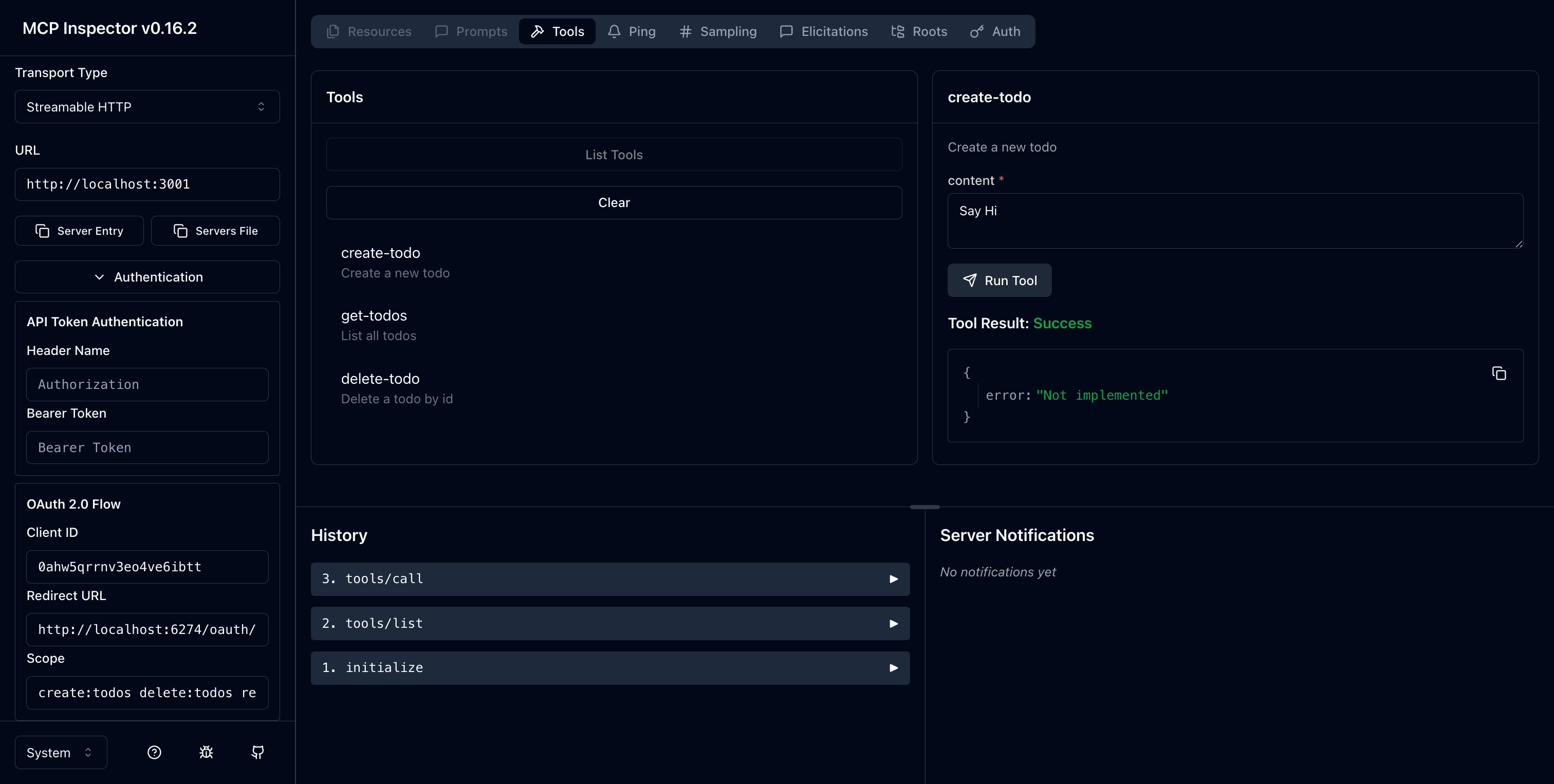
檢查點:執行 todo manager 工具
- 在 MCP inspector 上方選單點選「Tools」分頁
- 點擊「List Tools」按鈕
- 你應該會看到
create-todo、get-todos、delete-todo工具列在頁面上,點擊可檢視工具細節 - 右側會出現「Run Tool」按鈕,點擊並輸入必要參數執行工具
- 你會看到工具回傳的 JSON 結果
{"error": "Not implemented"}
與授權伺服器整合
完成本節需考慮以下幾點:
你的授權伺服器簽發者 (Issuer) URL
通常是你的授權伺服器基礎 URL,如 https://auth.example.com。有些簽發者可能為 https://example.logto.app/oidc,請參考你的簽發者文件。
如何取得授權伺服器中繼資料
- 若你的授權伺服器符合 OAuth 2.0 授權伺服器中繼資料 或 OpenID Connect Discovery,可用 MCP Auth 內建工具自動取得中繼資料
- 若不符合,需手動在 MCP 伺服器設定中指定中繼資料 URL 或端點,請查閱簽發者文件
如何將 MCP inspector 註冊為授權伺服器用戶端
- 若授權伺服器支援 動態用戶端註冊 (Dynamic Client Registration),MCP inspector 會自動註冊
- 若不支援,需手動將 MCP inspector 註冊為用戶端
瞭解權杖請求參數
向不同授權伺服器請求存取權杖時,指定目標資源與權限的方式可能不同,主要有:
-
資源標示符 (Resource indicator) 模式:
- 使用
resource參數指定目標 API(參見 [RFC 8707: OAuth 2.0 資源標示符]) - 現代 OAuth 2.0 常見
- 範例請求:
{ "resource": "http://localhost:3001", "scope": "create:todos read:todos" } - 伺服器會發出專屬於該資源的權杖
- 使用
-
受眾 (Audience) 模式:
- 使用
audience參數指定權杖目標 - 與資源標示符類似但語意不同
- 範例請求:
{
  "audience": "todo-api",
  "scope": "create:todos read:todos"
}
- 使用
-
純權限範圍 (Scope) 模式:
- 僅依權限範圍,不帶 resource / audience 參數
- 傳統 OAuth 2.0 作法
- 範例請求:
{ "scope": "todo-api:create todo-api:read openid profile" } - 常以前綴命名空間權限範圍
- 簡單 OAuth 2.0 實作常見
- 查閱簽發者文件以確認支援哪些參數
- 有些簽發者同時支援多種方式
- 資源標示符可提升安全性(限制受眾)
- 建議有支援時優先使用資源標示符以強化存取控制
每個簽發者可能有不同需求,以下步驟將引導你整合 MCP inspector 與 MCP 伺服器並進行專屬設定。
註冊 MCP inspector 為用戶端
- Logto
- OAuth 2.0 / OIDC
將 todo manager 與 Logto 整合非常簡單,因其為支援資源標示符與權限範圍的 OpenID Connect 簽發者,可用 http://localhost:3001 作為資源標示符保護 todo API。
由於 Logto 尚未支援動態用戶端註冊,你需手動將 MCP inspector 註冊為 Logto 租戶的用戶端:
- 開啟 MCP inspector,進入驗證 (Authentication) 設定並點擊「OAuth2.0 Flow」設定。複製 Redirect URI,如
http://localhost:6274/oauth/callback - 登入 Logto Console(或你的自架 Logto Console)
- 前往「應用程式」分頁,點擊「建立應用程式」。頁面底部點選「不使用框架建立應用程式」
- 填寫應用程式資訊後點擊「建立應用程式」:
- 選擇應用程式類型:選「單頁應用程式」
- 應用程式名稱:如「MCP Inspector」
- 在「設定 / Redirect URIs」區塊貼上剛才複製的 Redirect URI,然後點擊底部「儲存變更」
- 頁面上方卡片會顯示「App ID」,請複製
- 回到 MCP inspector,將「App ID」貼到驗證 (Authentication) 設定的「OAuth2.0 Flow」下的「Client ID」欄位
- 在「Scope」欄位輸入:
create:todos read:todos delete:todos,確保 Logto 回傳的存取權杖包含 todo manager 所需權限範圍
這是通用 OAuth 2.0 / OpenID Connect 簽發者整合指引。兩者步驟類似,因 OIDC 建立於 OAuth 2.0 之上。請查閱你的簽發者文件以獲得細節。
若你的簽發者支援動態用戶端註冊,可直接跳至第 8 步設定 MCP inspector;否則需手動註冊:
-
開啟 MCP inspector,進入驗證 (Authentication) 設定並點擊「OAuth2.0 Flow」設定。複製 Redirect URI,如
http://localhost:6274/oauth/callback -
登入你的簽發者管理後台
-
前往「應用程式」或「用戶端」區塊,建立新應用程式或用戶端
-
若需選擇用戶端類型,請選「單頁應用程式」或「公開用戶端」
-
建立應用程式後,需設定 redirect URI,貼上剛才複製的 Redirect URI
-
找到新應用程式的「Client ID」或「Application ID」並複製
-
回到 MCP inspector,將「Client ID」貼到驗證 (Authentication) 設定的「OAuth2.0 Flow」下的「Client ID」欄位
-
在「Scope」欄位輸入以下權限範圍以請求 todo 操作所需權限:
create:todos read:todos delete:todos設定 MCP Auth
首先,在 MCP 伺服器專案中安裝 MCP Auth SDK。
- Python
- Node.js
uv add mcpauth==0.2.0b1npm install mcp-auth@0.2.0-beta.1接下來需在 MCP 伺服器初始化 MCP Auth,主要分兩步:
- 取得授權伺服器中繼資料:供 MCP Auth 驗證授權伺服器發出的存取權杖,並將簽發者 (Issuer) 識別資訊納入資源中繼資料
- 設定受保護資源中繼資料:定義 MCP 伺服器的資源標示符與支援的權限範圍
步驟 1:取得授權伺服器中繼資料
根據 OAuth / OIDC 規範,可根據授權伺服器簽發者 (Issuer) URL 取得中繼資料。
- Logto
- OAuth 2.0 / OIDC
在 Logto,你可於 Logto Console 的應用程式詳細頁「Endpoints & Credentials / Issuer endpoint」區塊找到簽發者 (Issuer) URL,格式如 https://my-project.logto.app/oidc。
對於 OAuth 2.0 簽發者,請:
- 查閱簽發者文件取得授權伺服器 URL(常稱 issuer URL 或 base URL)
- 有些簽發者會在
https://{your-domain}/.well-known/oauth-authorization-server提供 - 於管理後台 OAuth / API 設定中查找
現在,使用 MCP Auth 工具函式取得授權伺服器中繼資料:
- Python
- Node.js
from mcpauth import MCPAuth
from mcpauth.config import AuthServerType
from mcpauth.utils import fetch_server_config

issuer_url = "<issuer-url>"  # 請替換為你的授權伺服器簽發者 (Issuer) URL

# 取得授權伺服器設定
auth_server_config = fetch_server_config(issuer_url, AuthServerType.OIDC) # 或 AuthServerType.OAUTH
import { MCPAuth, fetchServerConfig } from 'mcp-auth';
const issuerUrl = '<issuer-url>'; // 請替換為你的授權伺服器簽發者 (Issuer) URL
// 取得授權伺服器設定(OIDC Discovery)
const authServerConfig = await fetchServerConfig(issuerUrl, { type: 'oidc' }); // 或 { type: 'oauth' }若需其他方式取得授權伺服器中繼資料或自訂設定,請參考 其他設定方式。
步驟 2:設定受保護資源中繼資料
接著,在建立 MCP Auth 實例時設定受保護資源中繼資料。MCP 伺服器將透過 MCP Auth 對外公開這些資源中繼資料。
- Python
- Node.js
# server.py

# 其他 import...
from mcpauth.types import ResourceServerConfig, ResourceServerMetadata

# 定義本 MCP 伺服器的資源標示符
resource_id = "http://localhost:3001"

mcp_auth = MCPAuth(
    protected_resources=ResourceServerConfig(
        metadata=ResourceServerMetadata(
            resource=resource_id,
            # 上一步取得的授權伺服器中繼資料
            authorization_servers=[auth_server_config],
            # 本 MCP 伺服器支援的權限範圍
            scopes_supported=[
                "create:todos",
                "read:todos",
                "delete:todos"
            ]
        )
    )
)
// todo-manager.ts
// 定義本 MCP 伺服器的資源標示符
const resourceId = 'http://localhost:3001';
// 設定 MCP Auth 受保護資源中繼資料
const mcpAuth = new MCPAuth({
protectedResources: {
metadata: {
resource: resourceId,
// 上一步取得的授權伺服器中繼資料
authorizationServers: [authServerConfig],
// 本 MCP 伺服器支援的權限範圍
scopesSupported: [
"create:todos",
"read:todos",
"delete:todos"
]
}
}
});更新 MCP 伺服器
快完成了!現在要更新 MCP 伺服器,套用 MCP Auth 路由與中介軟體 (middleware),並根據使用者權限範圍實作 todo manager 工具的權限控管。
首先,套用受保護資源中繼資料路由,讓 MCP 用戶端可從 MCP 伺服器取得資源中繼資料。
- Python
- Node.js
# server.py

# ..其他程式碼

app = Starlette(
    routes=[
        # 設定受保護資源中繼資料路由
        # 讓 OAuth 用戶端可取得本資源伺服器的中繼資料
        *mcp_auth.resource_metadata_router().routes,
        Mount("/", app=mcp.streamable_http_app()),
    ],
    lifespan=lifespan,
)
// todo-manager.ts
// 設定受保護資源中繼資料路由
// 讓 OAuth 用戶端可取得本資源伺服器的中繼資料
app.use(mcpAuth.protectedResourceMetadataRouter());
接著,套用 MCP Auth 中介軟體至 MCP 伺服器。此中介軟體將處理所有進來請求的驗證 (Authentication) 與授權 (Authorization),確保只有授權使用者能存取 todo manager 工具。
- Python
- Node.js
# server.py

# 其他 import...
from starlette.middleware import Middleware

# 其他程式碼...

# 建立中介軟體
bearer_auth = Middleware(mcp_auth.bearer_auth_middleware('jwt', resource=resource_id, audience=resource_id))

app = Starlette(
    routes=[
        *mcp_auth.resource_metadata_router().routes,
        # 套用 MCP Auth 中介軟體
        Mount("/", app=mcp.streamable_http_app(), middleware=[bearer_auth]),
    ],
    lifespan=lifespan,
)
// todo-manager.ts
app.use(mcpAuth.protectedResourceMetadataRouter());
// 套用 MCP Auth 中介軟體
app.use(
mcpAuth.bearerAuth('jwt', {
resource: resourceId,
audience: resourceId,
})
);現在可以更新 todo manager 工具,讓其透過 MCP Auth 中介軟體進行驗證 (Authentication) 與授權 (Authorization)。
讓我們來更新工具實作。
- Python
- Node.js
# server.py

# 其他 import...

from typing import Any, List, Optional
from mcpauth.exceptions import MCPAuthBearerAuthException, BearerAuthExceptionCode
from mcpauth.types import AuthInfo, ResourceServerConfig, ResourceServerMetadata

# 下一節會提到
from service import TodoService

def assert_user_id(auth_info: Optional[AuthInfo]) -> str:
    """確認 auth_info 包含有效 user ID 並回傳。"""
    if not auth_info or not auth_info.subject:
        raise Exception("Invalid auth info")
    return auth_info.subject

def has_required_scopes(user_scopes: List[str], required_scopes: List[str]) -> bool:
    """檢查使用者是否具備所有必要權限範圍。"""
    return all(scope in user_scopes for scope in required_scopes)

# 建立 TodoService 實例
todo_service = TodoService()

@mcp.tool()
def create_todo(content: str) -> dict[str, Any]:
    """建立新的待辦事項。需 'create:todos' 權限範圍。"""
    auth_info = mcp_auth.auth_info
    user_id = assert_user_id(auth_info)

    # 只有具備 'create:todos' 權限範圍的使用者可建立
    user_scopes = auth_info.scopes if auth_info else []
    if not has_required_scopes(user_scopes, ["create:todos"]):
        raise MCPAuthBearerAuthException(BearerAuthExceptionCode.MISSING_REQUIRED_SCOPES)

    created_todo = todo_service.create_todo(content=content, owner_id=user_id)
    return created_todo

@mcp.tool()
def get_todos() -> dict[str, Any]:
    """
    列出待辦事項。具備 'read:todos' 權限範圍的使用者可檢視所有待辦事項,
    否則僅能檢視自己的。
    """
    auth_info = mcp_auth.auth_info
    user_id = assert_user_id(auth_info)

    # 有 'read:todos' 權限範圍可存取所有,否則僅能存取自己的
    user_scopes = auth_info.scopes if auth_info else []
    todo_owner_id = None if has_required_scopes(user_scopes, ["read:todos"]) else user_id

    todos = todo_service.get_all_todos(todo_owner_id)
    return {"todos": todos}

@mcp.tool()
def delete_todo(id: str) -> dict[str, Any]:
    """
    根據 id 刪除待辦事項。使用者可刪除自己的,
    具備 'delete:todos' 權限範圍者可刪除任何待辦事項。
    """
    auth_info = mcp_auth.auth_info
    user_id = assert_user_id(auth_info)

    todo = todo_service.get_todo_by_id(id)

    if not todo:
        return {"error": "Failed to delete todo"}

    # 只有自己的可刪除,具備 'delete:todos' 權限範圍者可刪除任何
    user_scopes = auth_info.scopes if auth_info else []
    if todo.owner_id != user_id and not has_required_scopes(user_scopes, ["delete:todos"]):
        return {"error": "Failed to delete todo"}

    deleted_todo = todo_service.delete_todo(id)

    if deleted_todo:
        return {
            "message": f"Todo {id} deleted",
            "details": deleted_todo
        }
    else:
        return {"error": "Failed to delete todo"}
// todo-manager.ts
// 其他 import...
import assert from 'node:assert';
import { fetchServerConfig, MCPAuth, MCPAuthBearerAuthError } from 'mcp-auth';
import { type AuthInfo } from '@modelcontextprotocol/sdk/server/auth/types.js';
// 下一節會提到
import { TodoService } from './todo-service.js';
const assertUserId = (authInfo?: AuthInfo) => {
const { subject } = authInfo ?? {};
assert(subject, 'Invalid auth info');
return subject;
};
const hasRequiredScopes = (userScopes: string[], requiredScopes: string[]): boolean => {
return requiredScopes.every((scope) => userScopes.includes(scope));
};
const todoService = new TodoService();
server.tool(
'create-todo',
'Create a new todo',
{ content: z.string() },
({ content }: { content: string }, { authInfo }) => {
const userId = assertUserId(authInfo);
/**
* 只有具備 'create:todos' 權限範圍的使用者可建立
*/
if (!hasRequiredScopes(authInfo?.scopes ?? [], ['create:todos'])) {
throw new MCPAuthBearerAuthError('missing_required_scopes');
}
const createdTodo = todoService.createTodo({ content, ownerId: userId });
return {
content: [{ type: 'text', text: JSON.stringify(createdTodo) }],
};
}
);
server.tool('get-todos', 'List all todos', ({ authInfo }) => {
const userId = assertUserId(authInfo);
/**
* 有 'read:todos' 權限範圍可存取所有(todoOwnerId = undefined)
* 否則僅能存取自己的(todoOwnerId = userId)
*/
const todoOwnerId = hasRequiredScopes(authInfo?.scopes ?? [], ['read:todos'])
? undefined
: userId;
const todos = todoService.getAllTodos(todoOwnerId);
return {
content: [{ type: 'text', text: JSON.stringify(todos) }],
};
});
server.tool(
'delete-todo',
'Delete a todo by id',
{ id: z.string() },
({ id }: { id: string }, { authInfo }) => {
const userId = assertUserId(authInfo);
const todo = todoService.getTodoById(id);
if (!todo) {
return {
content: [{ type: 'text', text: JSON.stringify({ error: 'Failed to delete todo' }) }],
};
}
/**
* 只有自己的可刪除,具備 'delete:todos' 權限範圍者可刪除任何
*/
if (todo.ownerId !== userId && !hasRequiredScopes(authInfo?.scopes ?? [], ['delete:todos'])) {
return {
content: [
{
type: 'text',
text: JSON.stringify({ error: 'Failed to delete todo' }),
},
],
};
}
const deletedTodo = todoService.deleteTodo(id);
return {
content: [
{
type: 'text',
text: JSON.stringify({
message: `Todo ${id} deleted`,
details: deletedTodo,
}),
},
],
};
}
);現在,建立上述程式碼所用的「Todo service」以實作相關功能:
- Python
- Node.js
建立 service.py 作為 Todo service:
"""
簡易 Todo 服務,僅供示範用途。
以記憶體列表儲存 todos。
"""

from datetime import datetime
from typing import List, Optional, Dict, Any
import random
import string

class Todo:
    """代表一個待辦事項。"""

    def __init__(self, id: str, content: str, owner_id: str, created_at: str):
        self.id = id
        self.content = content
        self.owner_id = owner_id
        self.created_at = created_at

    def to_dict(self) -> Dict[str, Any]:
        """轉換為 dict 以供 JSON 序列化。"""
        return {
            "id": self.id,
            "content": self.content,
            "ownerId": self.owner_id,
            "createdAt": self.created_at
        }


class TodoService:
    """簡易 Todo 服務,僅供示範用途。"""

    def __init__(self):
        self._todos: List[Todo] = []

    def get_all_todos(self, owner_id: Optional[str] = None) -> List[Dict[str, Any]]:
        """
        取得所有 todos,可選擇依 owner_id 過濾。

        Args:
            owner_id: 若提供,僅回傳該使用者的 todos

        Returns:
            todo 字典列表
        """
        if owner_id:
            filtered_todos = [todo for todo in self._todos if todo.owner_id == owner_id]
            return [todo.to_dict() for todo in filtered_todos]
        return [todo.to_dict() for todo in self._todos]

    def get_todo_by_id(self, todo_id: str) -> Optional[Todo]:
        """
        依 ID 取得 todo。

        Args:
            todo_id: 欲取得的 todo ID

        Returns:
            找到則回傳 Todo 物件,否則 None
        """
        for todo in self._todos:
            if todo.id == todo_id:
                return todo
        return None

    def create_todo(self, content: str, owner_id: str) -> Dict[str, Any]:
        """
        建立新 todo。

        Args:
            content: todo 內容
            owner_id: 擁有者 ID

        Returns:
            建立的 todo 字典
        """
        todo = Todo(
            id=self._generate_id(),
            content=content,
            owner_id=owner_id,
            created_at=datetime.now().isoformat()
        )
        self._todos.append(todo)
        return todo.to_dict()

    def delete_todo(self, todo_id: str) -> Optional[Dict[str, Any]]:
        """
        依 ID 刪除 todo。

        Args:
            todo_id: 欲刪除的 todo ID

        Returns:
            刪除的 todo 字典,若未找到則 None
        """
        for i, todo in enumerate(self._todos):
            if todo.id == todo_id:
                deleted_todo = self._todos.pop(i)
                return deleted_todo.to_dict()
        return None

    def _generate_id(self) -> str:
        """產生隨機 todo ID。"""
        return ''.join(random.choices(string.ascii_lowercase + string.digits, k=8))
建立 todo-service.ts 作為 Todo service:
// todo-service.ts

type Todo = {
  id: string;
  content: string;
  ownerId: string;
  createdAt: string;
};

/**
 * 簡易 Todo 服務,僅供示範用途。
 * 以記憶體陣列儲存 todos
 */
export class TodoService {
  private readonly todos: Todo[] = [];

  getAllTodos(ownerId?: string): Todo[] {
    if (ownerId) {
      return this.todos.filter((todo) => todo.ownerId === ownerId);
    }
    return this.todos;
  }

  getTodoById(id: string): Todo | undefined {
    return this.todos.find((todo) => todo.id === id);
  }

  createTodo({ content, ownerId }: { content: string; ownerId: string }): Todo {
    const todo: Todo = {
      id: this.genId(),
      content,
      ownerId,
      createdAt: new Date().toISOString(),
    };

    // eslint-disable-next-line @silverhand/fp/no-mutating-methods
    this.todos.push(todo);
    return todo;
  }

  deleteTodo(id: string): Todo | undefined {
    const index = this.todos.findIndex((todo) => todo.id === id);

    if (index === -1) {
      return undefined;
    }

    // eslint-disable-next-line @silverhand/fp/no-mutating-methods
    const [deleted] = this.todos.splice(index, 1);
    return deleted;
  }

  private genId(): string {
    return Math.random().toString(36).slice(2, 10);
  }
}
🎉 恭喜!我們已成功實作一個具備驗證 (Authentication) 與授權 (Authorization) 的完整 MCP 伺服器!
你也可以參考我們的範例程式碼:
- Python
- Node.js
完整 MCP 伺服器(OIDC 版本)程式碼請參考 MCP Auth Python SDK repository。
完整 MCP 伺服器(OIDC 版本)程式碼請參考 MCP Auth Node.js SDK repository。
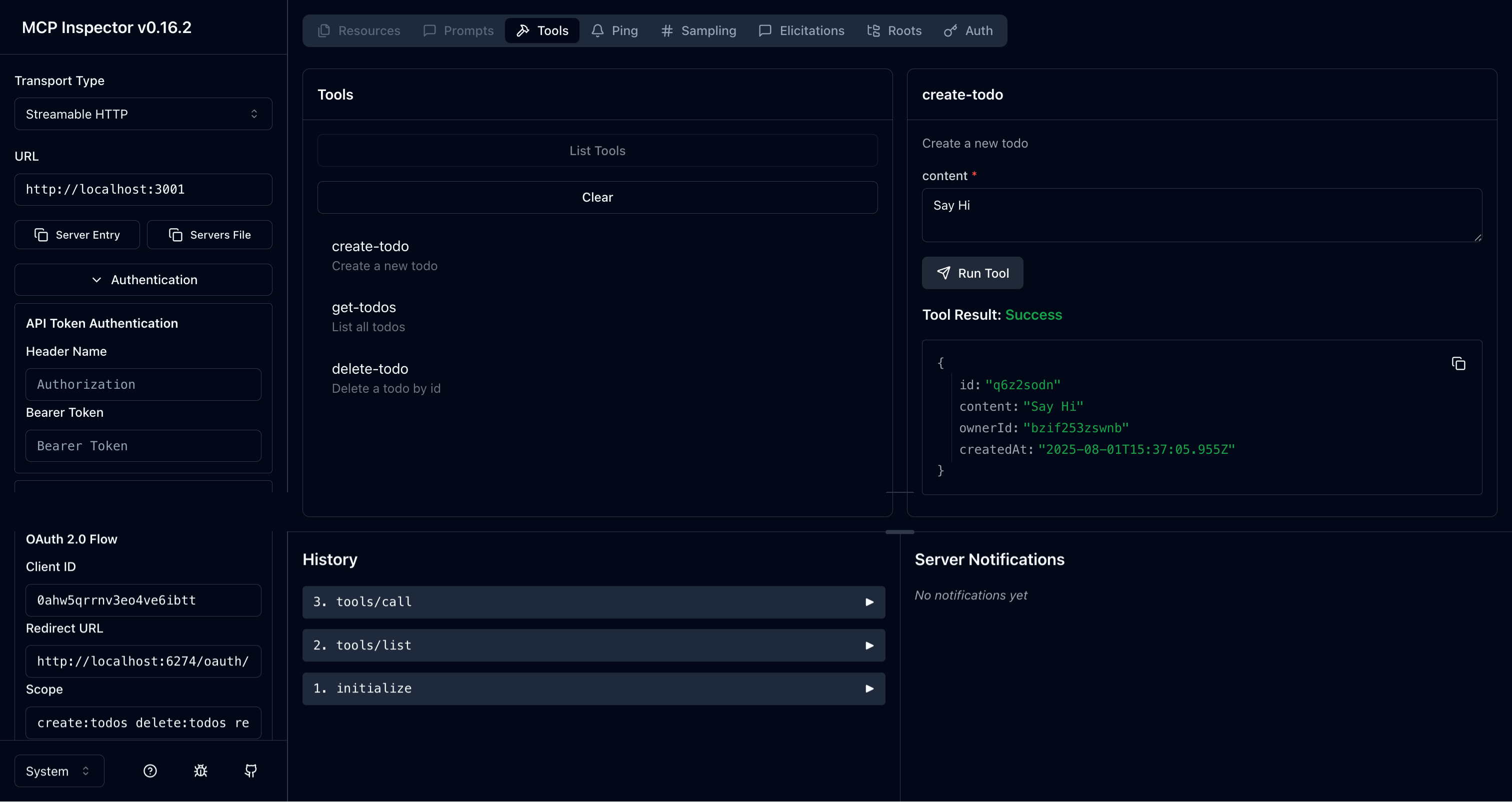
檢查點:執行 todo-manager 工具
重新啟動 MCP 伺服器並於瀏覽器開啟 MCP inspector。點擊「Connect」按鈕時,你應會被導向授權伺服器的登入頁面。
登入並返回 MCP inspector 後,重複前述步驟執行 todo manager 工具。這次你將以已驗證 (Authentication) 的使用者身分使用這些工具。工具行為會根據你帳號的角色與權限而異:
-
若以 User(僅有
create:todos權限範圍)登入:- 可用
create-todo工具建立新待辦事項 - 僅能檢視與刪除自己的待辦事項
- 無法檢視或刪除其他使用者的待辦事項
- 可用
-
若以 Admin(具備所有權限範圍:
create:todos、read:todos、delete:todos)登入:- 可建立新待辦事項
- 可用
get-todos工具檢視系統所有待辦事項 - 可用
delete-todo工具刪除任何待辦事項,不論擁有者
你可以透過以下方式測試不同權限層級:
- 登出目前 session(於 MCP inspector 點擊「Disconnect」)
- 以不同權限的帳號登入
- 重複執行相同工具,觀察行為如何隨使用者權限變化
這展現了角色型存取控制 (RBAC) 的實際運作,不同使用者對系統功能有不同存取層級。
- Python
- Node.js
完整 MCP 伺服器(OIDC 版本)程式碼請參考 MCP Auth Python SDK repository。
完整 MCP 伺服器(OIDC 版本)程式碼請參考 MCP Auth Node.js SDK repository。
結語
🎊 恭喜!你已順利完成本教學。讓我們回顧一下:
- 建立具備 todo 管理工具(
create-todo、get-todos、delete-todo)的基本 MCP 伺服器 - 實作不同使用者與管理員權限層級的角色型存取控制 (RBAC)
- 透過 MCP Auth 將 MCP 伺服器與授權伺服器整合
- 設定 MCP Inspector 以驗證 (Authentication) 使用者並使用帶有權限範圍的存取權杖呼叫工具
歡迎參閱其他教學與文件,充分發揮 MCP Auth 的強大功能。